Your Company Already Has the Data. You Just Can't See It.
Every business owner I talk to says the same thing within the first ten minutes: “We don’t really have data.”
They’re wrong.
What they mean is: “We don’t have a clean database with dashboards and KPIs.” But that’s not what AI needs. AI needs examples. And you don’t need perfect data — you need accessible data. Examples are hiding everywhere in your business, in formats you’ve stopped thinking of as data.
Your Oldest Data Is Your Biggest Advantage
Before I show you where the data is hiding, let me tell you why it matters that you’ve been in business for 15 or 25 or 40 years.
A startup that launched last year has twelve months of records to learn from. Your business has decades. That’s not just more data — it’s data that spans recessions, booms, monsoon seasons, team changes, raw material price swings, and regulatory shifts. No synthetic dataset captures that. No competitor can buy it. No amount of clean infrastructure replicates the messy, rich, compounding record of a business that’s actually survived.
Your competitor with the shiny new ERP and the Tableau dashboards? They’d trade it all for your depth. They just don’t know it yet. Neither do you — because your depth is locked in formats nobody thinks of as data.
The Data You Don’t Know You Have
These are drawn from our Basecamp sessions — names changed, details real. Here’s what “we don’t have data” looks like once we map it:
A construction chemicals manufacturer in Pune — 35 people, 23 years in business — has quoted over 3,200 projects. Every single one involved a quotation, a material estimate, a site visit report, and a final invoice. Those documents exist — in Outlook threads, in folders on the estimator’s desktop, in Tally entries going back to 2004. Nobody thinks of that as a dataset. It is. It’s 3,200 examples of “given this substrate type, this square footage, this location, and this season — here’s what it cost, how long it took, and what went wrong.”
A CA firm in Navi Mumbai with 18 people has fifteen years of client files. Engagement letters, ITR working papers, audit reports, billing records, and fifteen Marches’ worth of filing season notes. Each file records what the client needed, what the team delivered, how long each return took, which clients sent documents late, and which ones complained. Fifteen years of that is a pattern library — enough to predict this year’s bottlenecks from last year’s data before filing season even starts.
A systematic trader in South India has eight years of transaction logs — 150+ orders a day, position histories, strategy notes, P&L records. Every entry is a timestamped record of a decision and its outcome across multiple market regimes. Ask him if he has data, and he’ll say “just some spreadsheets.” Those spreadsheets contain more decision-quality signal than most institutional research desks build on purpose.
Why You Can’t See It
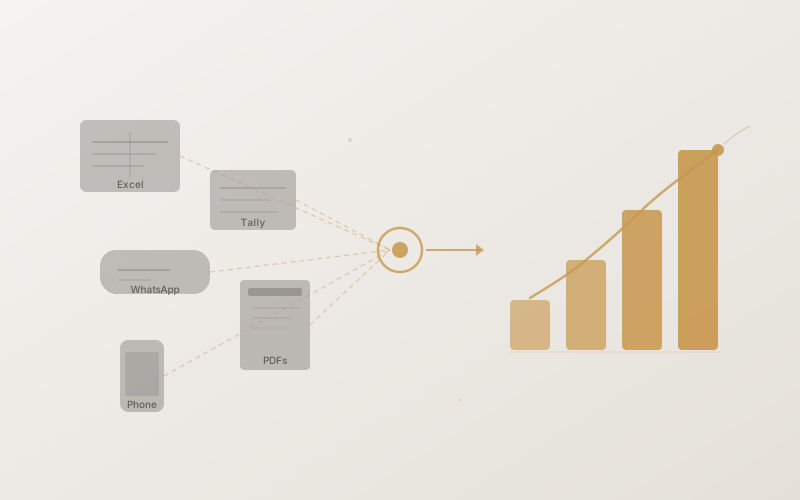
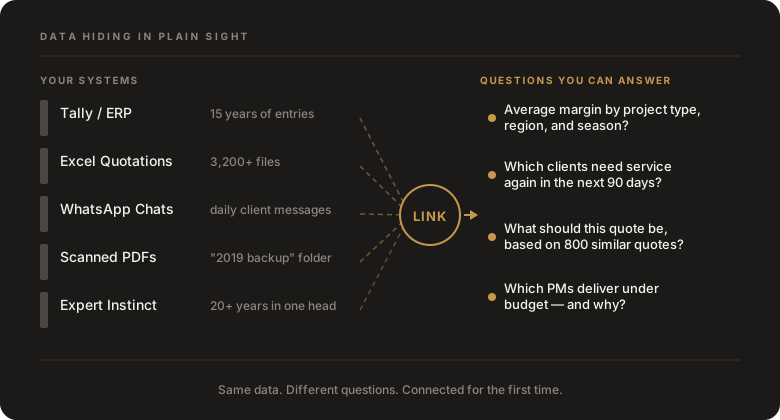
Your quotations are in Excel. Your project records are in Tally. Your client communication is on WhatsApp. Your site photos are on someone’s phone. Your old invoices are scanned PDFs in a folder called “2019 backup” on a hard drive in the accounts department.
The data exists. It just doesn’t exist together.
And then there’s the data that isn’t in any system at all. Your most experienced project manager knows that exterior waterproofing work always runs 15% over budget during monsoon. Your senior CA partner knows which clients will send Form 16 on the last possible day — one partner told us she could name them by heart. Your best salesperson knows which leads will convert after the second meeting and which are just shopping around.
That knowledge is data too — but it’s trapped in individual expertise, invisible to everyone else in the company.
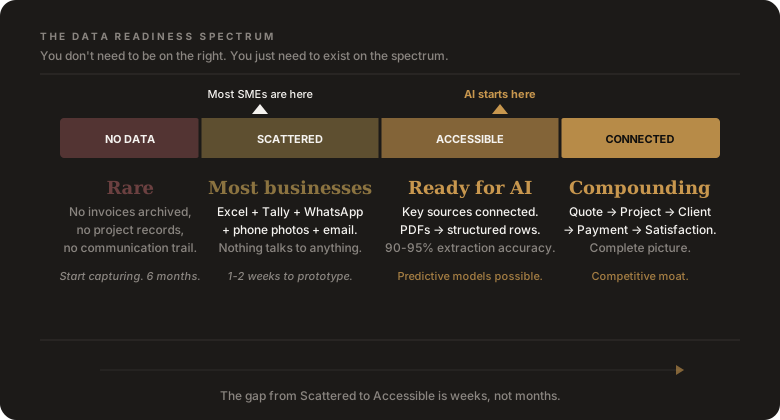
When business owners say “we don’t have data,” they’re picturing a tech company with a data warehouse and a team of analysts building dashboards. That’s the finish line, not the starting point. The bar for “accessible” is much lower than you think.
What This Looks Like in Practice
We did this at our own firm before we ever offered it to a client.
At our wealth management practice, report generation took 6+ hours per client because 80% of the time went to gathering data from disconnected sources — market feeds, custodian portals, regulatory updates — and cross-checking numbers across systems. The data existed everywhere. None of it talked to each other.
We connected three sources into a single staging layer, built extraction tools, and added automated validation. Three weeks of focused work, no new hires, no enterprise platform. Reports dropped from 6+ hours to under 2. The same four analysts now produce 3x the output. (Full case study here.)
That’s what “unlocking data” looks like. Not a six-month data warehouse project. A focused connection between sources that already exist.
How It Works: Connect, Structure, Link
None of this requires an enterprise budget.
Connect. For a 30-person manufacturing firm, this usually means pulling Tally exports, a quotation folder, and a project tracker into a single queryable format. A working prototype connecting your two or three most important sources takes one to two weeks. Full integration across all systems takes longer — four to eight weeks depending on how many sources and how messy the history.
Structure. A quotation PDF becomes a row: project type, area, materials, cost, margin, turnaround time. Extraction tools hit 90-95% accuracy on structured documents like invoices, purchase orders, and tax forms. Free-form documents — handwritten site notes, inconsistent quote formats from 2009 — are harder: 70-80% accuracy, with human review on the remainder. Still 5-10x faster than manual entry.
Link. The quotation links to the project completion record. The project links to the client. The client links to their payment history. Fragments become a complete picture.
Once that’s done, the questions change:
- “What’s our average margin on waterproofing projects in Maharashtra during monsoon?”
- “Which clients are most likely to need recoating in the next 90 days?”
- “What should this quotation be, based on 800 similar past quotes?”
- “Which project managers consistently deliver under budget, and what are they doing differently?”
These aren’t hypothetical. Your business has already generated the data to answer them.
When the Data Genuinely Isn’t There
I should be honest: sometimes a business really doesn’t have the data. If your team has been operating on verbal instructions with no written records for twenty years — no invoices archived, no project files kept, no client communication trail — then there’s nothing to unlock. The right first step is to start capturing: standardize your quotation format, log your project outcomes, save your client communication. Six months of disciplined capture gives AI enough to start working with.
But in over two decades of building systems for Indian businesses — manufacturing, financial services, professional services — I’ve encountered “we genuinely have no records” twice. Every other time, the data was there. Buried in Tally backups and email archives and folders on old laptops, but there.
The question was never whether it existed. It was whether someone would connect it before a competitor did.
Not sure what data your business is sitting on? Book a free Basecamp session — we’ll map your existing data assets in 45 minutes and show you what’s possible.