WhatsApp Se Document Collect Karna — CA Firm Ka Sabse Bada Headache
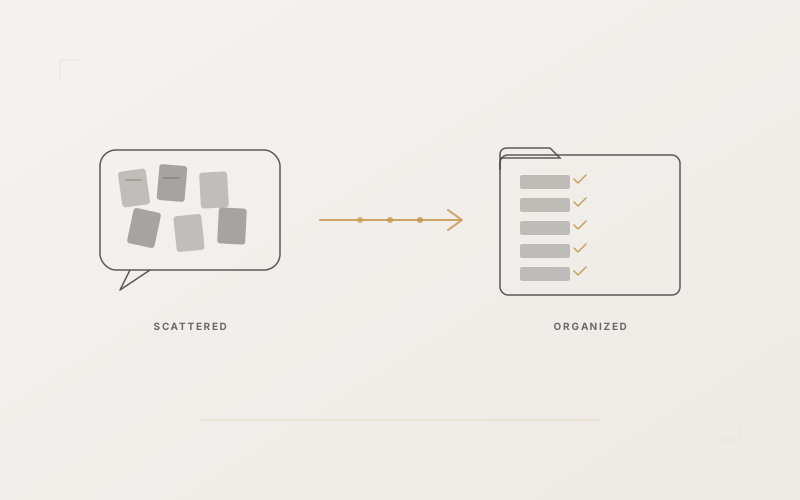
If you run a CA firm in India, I don’t need to explain this problem to you. You’re living it right now.
It’s filing season. You have 200 clients. Each one owes you 3-4 documents — PAN card, Form 16, bank statements, investment proofs. Some owe more. That’s 600-800 documents you need to collect, verify, organize, and file.
And where do all these documents come from? WhatsApp. Because that’s how India works.
The problem isn’t WhatsApp itself. Your clients are comfortable on WhatsApp. They’ll send you things on WhatsApp faster than they’ll respond to an email or upload to a portal. The problem is what happens after they send.
The WhatsApp chase cycle
Every CA firm I’ve talked to describes the same pattern. It’s almost comically universal:
Day 1: You send the client a checklist. “Please share the following documents: Form 16, bank statement (April 2025 to March 2026), 80C investment proofs, capital gains statement if applicable.”
Day 4: Silence. You send a polite reminder. “Sir, filing deadline aa raha hai, kindly share documents at the earliest.”
Day 6: The client responds. They send one document. It’s a screenshot of their Form 16 — not a PDF, a photo taken at an angle with their thumb visible in the corner. The salary figures are partially cut off.
Day 7: You reply asking for the PDF version. “Sir, screenshot se data nahi nikalte, PDF share kar dijiye please.”
Day 10: They send the PDF. But it’s Form 16 Part B only. Part A is missing.
Day 11: You explain the difference between Part A and Part B. The client says “achha, woh alag hota hai kya?”
Day 14: You finally get both parts. Now repeat this for bank statements, investment proofs, and everything else. For 200 clients.
Your staff isn’t doing accounting during filing season. They’re doing document logistics. The average CA firm I’ve worked with estimates that 40-50% of filing season effort goes to document collection and follow-up alone. Not analysis. Not filing. Just getting the inputs.
Why portals don’t work
I know what some of you are thinking: “Why not use a document upload portal?”
Many firms have tried. The results are almost always the same. You set up a portal — ClearTax has one, Zoho has one, there are standalone options. You send clients the link. Maybe 20% of your clients actually use it. The rest call you and say “Sir, yeh portal mein login nahi ho raha” or “mujhe WhatsApp pe hi bhej dena hai.”
You can’t fight client behavior. If your clients are on WhatsApp, your document collection needs to be on WhatsApp. The question is whether you handle that WhatsApp flow manually — which you’re doing now, and it’s killing you — or whether you make it smart.
The AI fix: let clients keep WhatsApping
Here’s what we build for CA firms. The principle is simple: don’t change client behavior, change what happens behind the scenes.
You set up a WhatsApp Business number specifically for document collection. Clients send documents to this number the same way they’d send to your staff — photos, PDFs, forwarded emails, voice notes saying “I’ll send the bank statement tomorrow,” whatever.
The difference is what happens when the message arrives.
Auto-classification
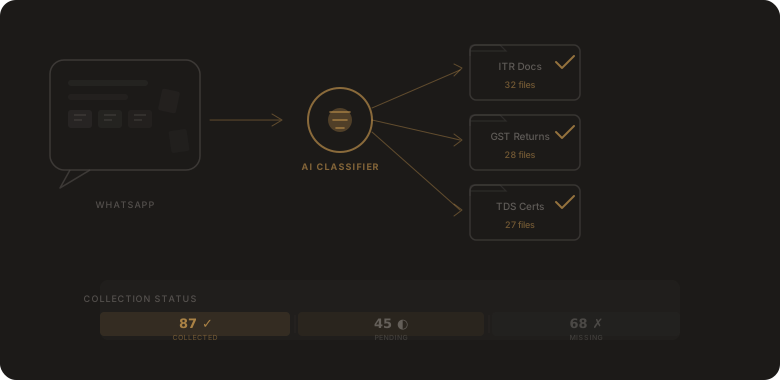
When a client sends a document, AI identifies what it is. Form 16? PAN card? Bank statement? Investment proof? It looks at the content — not just the filename (which is usually “IMG_20260315_142533.jpg” anyway) — and classifies it.
If it’s a photo of a document, it extracts the text (OCR) and still classifies it. If the photo is blurry or partially cut off — remember the angled screenshot with the thumb? — it auto-replies to the client: “Yeh document clearly nahi dikh raha. Thoda better quality mein bhej sakte ho kya? PDF ho toh best hai.”
Auto-filing
Your staff currently downloads each document from WhatsApp, renames it (“Sharma_PAN.pdf”), and drags it into the right folder on Google Drive. That’s 2-3 minutes per document, multiplied by 800 documents — an entire person-week, just on filing. With auto-classification, that step disappears. The document lands in the right client folder, in the right sub-folder, the moment it arrives.
Missing document tracking
This is where it gets genuinely useful. The system maintains a checklist for every client. When a document comes in, the checklist updates. At any point, you can see: Client A has submitted 3 of 5 documents — Form 16 and PAN received, bank statement received but wrong date range, investment proof and capital gains statement still pending.
Your staff doesn’t need to manually track what’s received and what isn’t. The system knows.
Personalized automated reminders
On a schedule you set — say day 3, day 7, day 10 after the initial request — the system sends personalized follow-ups. Not generic blasts. Specific messages:
“Sharma ji, aapke filing ke liye abhi bank statement (April 2025 - March 2026) aur 80C investment proofs pending hain. Form 16 mil gaya hai, dhanyavaad. Deadline 15 July hai, jaldi bhej dijiye.”
The client sees a message that’s clearly about their situation, not a copy-paste job. They respond faster because the message is specific about what’s missing.
What the setup looks like
Here’s the setup compressed into a week. Days 1-2: we import your client list and configure document checklists by client type (salaried, business owner, NRI). Days 3-4: WhatsApp Business number goes live, AI classification gets trained on your firm’s specific document types, auto-replies configured in Hindi, English, or both. Days 5-6: we run 50-100 real documents through the system, hit 90%+ classification accuracy, and flag the edge cases. Day 7: go live — your staff sends out the first document requests, and by evening, the dashboard shows exactly what’s received, what’s pending, and what’s overdue for every client. No more scrolling through chats, no more parallel Excel trackers, no more “maine toh bheja tha” arguments — the system timestamps everything.
All documents are encrypted in transit and at rest, processed locally, and never stored beyond the engagement. PAN, Aadhaar, bank statements — handled with the same care your firm already applies, just without the manual chaos.
The numbers from a real implementation
A firm we implemented this for — about 250 clients, 5-person team — tracked their filing season metrics before and after:
Document collection effort: Dropped from roughly 15 person-hours per day during peak season to about 4 hours (mostly reviewing edge cases and handling complex client situations).
Average time from first request to complete document set: Came down from 18 days to about 9 days. Not because clients became more responsible — because the reminders were consistent, specific, and timely. Turns out, people respond faster when you tell them exactly what’s missing instead of saying “please send documents.”
Staff morale: This is harder to quantify, but the firm’s partner told me his articled clerks used to dread February-July. The document chase was the single most frustrating part of their work. Removing that grind made a visible difference in how the team showed up.
The part nobody talks about
Here’s something I’ve noticed across every CA firm we’ve worked with: the document collection problem isn’t just a filing season problem. It’s a year-round problem.
GST filings need purchase invoices monthly. Tax planning needs salary slips and investment details quarterly. Audit needs vouchers and bank statements. The same chase cycle repeats twelve months a year — it just intensifies during filing season.
A document collection system built for filing season works year-round. The same WhatsApp number, the same classification engine, the same tracking dashboard. The checklist templates change, but the workflow stays the same.
So when a CA firm asks me “is this worth it just for filing season?” — my honest answer is: you’ll use this system every month. Filing season is just when the pain is loud enough for you to finally fix it.
Filing season is just when the pain is loud enough to fix it — but this system works year-round. We can set it up in a week. One WhatsApp number, one system, and your staff gets their time back.