WhatsApp + AI — Why Indian Businesses Don't Need a CRM
Most Indian small businesses don’t need a CRM. They already have one. It’s called WhatsApp.
I’m a Chartered Accountant. I’ve run a practice. I’ve tried the CRM route. And I’ve seen what actually works in the real world — not the world of software demos and “best practices” webinars.
The CRM lie
Every year, some well-meaning consultant (or some very strategic salesperson) tells Indian SMEs the same thing: “You need a proper CRM. You can’t run a business on WhatsApp.”
So the business owner buys Zoho CRM. Or Freshsales. Or HubSpot. They pay for the annual plan because the discount is too good to pass up. They attend the onboarding call. They import their contacts. They set up the pipeline stages.
And then… nothing.
Two weeks later, the sales team is back on WhatsApp. The support team is back on WhatsApp. The owner is back on WhatsApp. CRM mein last login: 14 din pehle. Dashboard pe zero activity aur renewal ka email aa raha hai.
I know this because I lived it.
My Zoho experiment
Three years ago, I set up Zoho CRM for our CA practice. Proper setup — pipeline for new client onboarding, stages for document collection, task assignments for the team, automated reminders, the works.
My team used it for exactly 11 weeks.
Here’s what happened: a client would WhatsApp me about their GST filing. I’d reply on WhatsApp because that’s where the conversation was. Then I was supposed to go to Zoho, create a task, assign it to the right person, and update the status. For one client interaction, I now had two places to update — the actual conversation (WhatsApp) and the tracking system (Zoho).
My team had the same problem, except worse. They’d get client documents on WhatsApp — photos of invoices, scanned PAN cards, voice notes explaining deductions. All of it lived in WhatsApp. Logging it into Zoho meant downloading, uploading, tagging, and updating a pipeline stage. For every. Single. Interaction.
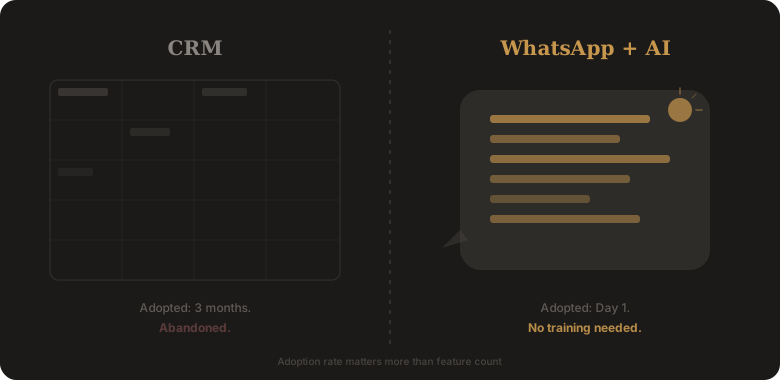
Within a month, the team was doing the client work on WhatsApp and “updating Zoho later.” Later became never. The CRM showed a beautiful, empty pipeline while 200+ client engagements hummed along in WhatsApp groups and DMs.
I cancelled the subscription. Not because Zoho is a bad product — it’s excellent. But because it was solving a problem we didn’t have, while ignoring the problem we did.
The actual problem
The problem was never “we don’t have a system.” The problem was “our system doesn’t organize itself.”
WhatsApp is where Indian business actually happens. Clients don’t email you — they WhatsApp you. Suppliers don’t call your office line — they send a WhatsApp message. Your own team coordinates on WhatsApp groups. Payment confirmations, delivery photos, meeting schedules, complaints, compliments — it all lives in WhatsApp.
This isn’t a bug. It’s not “unprofessional.” Yeh 50 crore logon ki aadat hai — isse badalna time ki barbaadi hai.
The real problem is that WhatsApp is a river — everything flows through it, but nothing stays organized. A client instruction from last Tuesday is buried under 200 messages. A follow-up you promised last week is forgotten because it scrolled off the screen. A quote request is sitting in your DMs while you’re responding to a different fire in a group chat.
You don’t need to replace WhatsApp. You need to make WhatsApp smarter.
The AI layer that actually works
Let me describe this as a Monday morning instead of a feature list.
You open WhatsApp. You send one message: “What’s overdue?” You get a list. Client-wise. Priority-sorted. With links to the original conversations. No scrolling through 40 chats. No opening a dashboard you forgot the password for.
A client messaged last week: “Paresh bhai, meri ITR file kar do, documents bhej raha hoon.” The AI already caught that, logged it as a task, and has been tracking whether the documents arrived. They didn’t — so it’s on your overdue list now, with context.
You told another client “I’ll send the draft by Thursday.” It’s Friday. The AI flagged that too — not in a CRM you have to check, but right here in WhatsApp. Where you’re already working.
Behind the scenes, every client interaction, every document received, every commitment made — logged without anyone doing a single extra step. No downloading. No uploading. No “update the CRM.” Your team works exactly the way they already work. The AI handles the organizing.
The AI reads only conversations your team chooses to share through the Business account, not personal chats. Everything stays encrypted.
Zero behavior change
The single biggest reason CRM implementations fail in Indian SMEs is behavior change. You’re asking people to adopt a new tool, learn a new interface, remember to update a separate system after every client interaction. That’s a tax on every single task, every single day.
The WhatsApp AI layer requires none of that. Your team keeps using WhatsApp exactly as they do now. The AI works in the background. The output — organized data, tracked commitments, automated follow-ups — appears in the same place they’re already looking.
What this looks like in practice
Let me give you a real example from a CA practice similar to ours (details changed for privacy).
Before the AI layer: The CA had 180 active clients. Client instructions came in via WhatsApp, phone calls, and occasionally email. The team maintained a shared Excel sheet to track filings — manually updated, usually two days behind reality. Clients would message asking for status updates; answering these took 1-2 hours daily because someone had to check the Excel sheet, cross-reference it with actual work done, and reply. Things fell through cracks regularly — not because the team was careless, but because the volume was unmanageable.
After the AI layer: Same 180 clients. Same WhatsApp conversations. But now every client instruction gets auto-logged. Every deadline gets tracked. The daily status inquiry load dropped by 80% because clients get proactive updates before they ask. The Excel tracking sheet became unnecessary — the AI maintains a live dashboard pulled directly from WhatsApp conversations. And the team’s time? Redirected from tracking and updating to actual advisory work.
The CA told me: “Pehle main accountant tha jo CRM bhi chalata tha. Ab main sirf accountant hoon. That’s what I signed up for.”
When a CRM actually makes sense
I’m not anti-CRM. There are legitimate cases where a proper CRM is the right choice:
- Large sales teams (10+) where multiple people interact with the same prospect and need shared visibility
- Complex B2B sales cycles with multi-month pipelines and multiple decision-makers
- Companies where email is the primary communication channel (more common in B2B SaaS, less common in Indian services)
- Regulatory requirements that mandate formal interaction logging (some financial services)
If any of these describe you, get a CRM. Seriously.
But if you’re a 5-to-30-person business where client communication happens primarily on WhatsApp — which describes about 90% of Indian SMEs — you’re better served by making WhatsApp work harder than by adding another tool your team will ignore.
The contrarian bet
The way Indian businesses communicate — personal, conversational, WhatsApp-first — isn’t a problem to be fixed. It’s a strength to be augmented.
The AI layer doesn’t ask you to change how you work. It makes how you already work more powerful. That’s a fundamentally different proposition from “adopt our platform.”
Stop paying for software your team ignores. Let’s make WhatsApp work instead.