The Real ROI of AI — It's Not What You Think
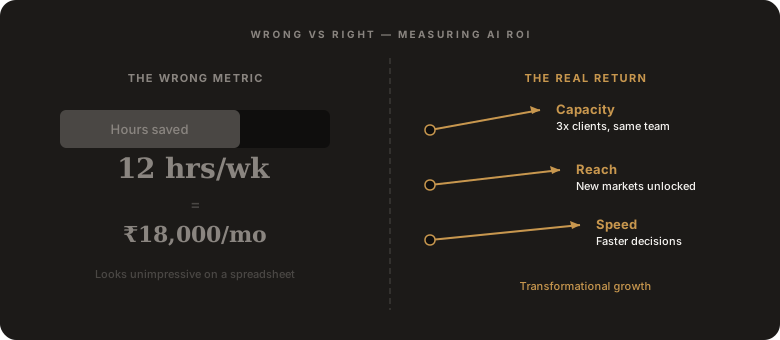
Here’s a number that means almost nothing: “We saved 12 hours a week with AI.”
I hear it constantly. Businesses pitch me their AI wins and the headline is always about time saved. And look, saving time is great. But if those 12 hours just turned into longer lunch breaks and extra scrolling, what exactly did you gain?
The real ROI of AI has nothing to do with hours saved. It has everything to do with what becomes possible that wasn’t possible before.
The Wrong Way to Measure AI ROI
Most businesses measure AI the same way they measure a new hire: input vs. output. How many hours did the tool save? How many documents did it process? What’s the cost per task?
This makes sense on a spreadsheet. It makes no sense in reality.
If you automate a report that took 4 hours and now takes 20 minutes, the spreadsheet says you saved 3 hours 40 minutes. Multiply by the employee’s hourly cost. That’s your ROI.
But that calculation misses the point entirely. It assumes the only value of that employee’s time is doing more of the same thing. It treats your business like a factory floor where the goal is throughput of identical widgets.
Your business isn’t a factory. The real question is: what does your team do with those 3 hours and 40 minutes that they literally could not do before?
The Right Way: Capacity, Reach, Speed
When we work with businesses at Basalt, we measure three things that actually matter:
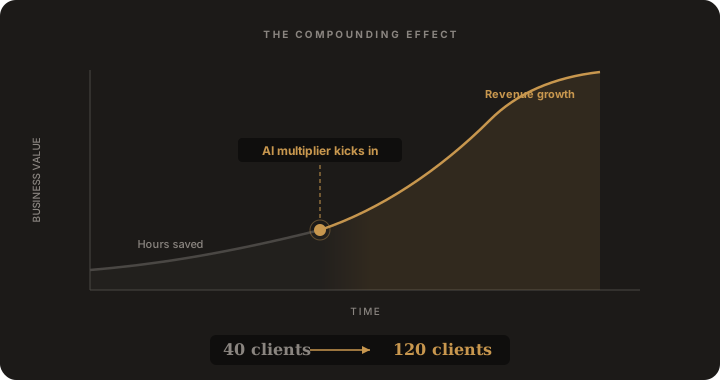
Capacity — Can you serve more clients without hiring proportionally? A CA firm we worked with was stuck at 40 clients. Not because they lacked skill, but because every new client meant more data entry, more compliance formatting, more reconciliation grunt work. Their people were drowning in process, not in thinking. After we automated the repetitive compliance and data workflows, the same team — no new hires — scaled to 120 clients within eight months. The “hours saved” metric would have said maybe 15 hours a week. The actual ROI was 3x revenue growth.
Reach — Can you enter markets or serve customer segments that were previously uneconomical? A mid-size manufacturer we advised was losing orders because their quoting process took 3-4 days. For large orders, customers waited. For smaller orders, they just went to a competitor. We built an AI-assisted quoting system that generates accurate estimates in under 2 hours. They didn’t save time on existing quotes — they started winning an entire category of business they were invisible to before.
Speed — Can you catch problems or seize opportunities faster than your competition? That same manufacturer had quality control inspectors reviewing samples manually. They were good at their jobs, but they could only inspect so many units per shift. An AI vision system now flags defects 3x faster and catches micro-defects that human eyes miss at production speed. The ROI isn’t “inspector hours saved.” It’s the six-figure client they kept because a defective batch got caught before shipping.
The Compounding Effect
Here’s what the spreadsheet really can’t capture: these gains compound.
The CA firm that went from 40 to 120 clients? Their reputation grew. They started attracting larger, more complex clients — the kind they always wanted but couldn’t pursue because they didn’t have bandwidth. Their average revenue per client went up alongside their client count.
That’s not addition. That’s multiplication.
When AI ROI Is Negative
I’m going to be honest about something most AI consultants won’t say: sometimes the ROI is negative, and you shouldn’t do it.
AI is a bad investment when:
- The problem is people, not process. If your team isn’t following existing workflows, automating those workflows just gives you faster chaos.
- Your data is a mess. AI trained on garbage data gives you confident, fast, wrong answers. That’s worse than slow, correct, human answers.
- You’re automating something that happens 5 times a month. If the task isn’t high-volume or high-value, the implementation cost will never pay back.
- You haven’t defined what “better” looks like. If you can’t articulate what success means before you start, you definitely won’t recognize it after.
We’ve talked businesses out of AI projects. More than once. Because a negative ROI doesn’t just waste money — it poisons the well. Your team will remember “we tried AI and it didn’t work” for years, and that makes it harder to do the smart AI project when it actually comes along.
So How Do You Know?
Start by asking better questions. Not “how can AI save us time?” but:
- What would we do if we could handle 3x our current volume?
- Which customers are we turning away because we can’t serve them fast enough?
- Where are we losing deals to faster competitors?
- What decisions are we making with gut feel that should be backed by data?
If the answers to those questions point to real revenue — real growth you’re leaving on the table — then AI has a shot at transformational ROI. Not 12-hours-a-week ROI. The kind that changes what your business is capable of.
Want to figure out where the real ROI is hiding in your business? Book a free Basecamp session — 45 minutes, no slides, no sales pitch. Just an honest look at what’s possible.