Is Your Business Ready for AI? An Honest Checklist
The bravest thing a consultant can say is “you’re not ready yet.”
And sometimes, we do. Not because we don’t want your business — but because pushing AI into an unprepared organization wastes your money and your team’s goodwill. When AI fails because the ground wasn’t ready, people blame the technology. Then it becomes twice as hard to try again when the timing is actually right.
So before you invest in any AI initiative — whether that’s a vendor pitch, an internal experiment, or a conversation with us — run through this checklist honestly.
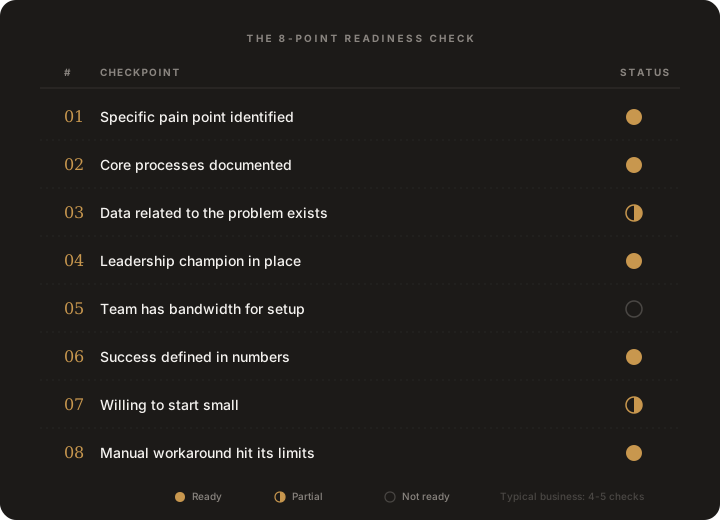
The Checklist
1. You have a specific pain point
Not “we should probably do something with AI.” A real, named problem. Something that costs you time, money, or sleep.
Ready: “Our accounts receivable team spends 15 hours a week chasing invoice discrepancies manually.” Not ready: “AI is the future and we don’t want to be left behind.”
2. Your core processes are somewhat documented
They don’t need to be in a polished SOP manual. But if you asked three people how a task gets done and got three completely different answers, AI won’t know which version to learn from.
Ready: “We have a rough workflow — some of it is in spreadsheets, some in people’s heads, but we can walk you through it.” Not ready: “Honestly, only Ramesh knows how that works, and he’s been on leave.”
3. You have data related to that pain point
It doesn’t need to be clean. It doesn’t need to be in a database. But it needs to exist. Invoices in a folder, entries in Tally, transactions in Excel — all fair game. No data means no AI.
Ready: “We have three years of purchase orders in spreadsheets. It’s messy, but it’s there.” Not ready: “We don’t really track that anywhere.”
4. Someone in leadership will champion the project
AI projects that start in a corner and hope to impress the boss later almost always die. You need someone with authority who will protect the project’s time and resources, even when daily fires compete for attention.
Ready: “Our director is the one who brought this up. She’ll make time for reviews.” Not ready: “The management team isn’t really aware we’re exploring this.”
5. Your team isn’t already drowning
This one surprises people. If your team is at 120% capacity just keeping the lights on, adding an AI project — even a helpful one — creates more chaos before it creates relief. There’s a setup cost: answering questions, reviewing outputs, adjusting workflows.
Ready: “We’re busy, but we can carve out a few hours a week for this.” Not ready: “We haven’t taken a breath since last quarter. Everyone is firefighting.”
6. You can define what “success” looks like in numbers
“Make things better” isn’t a goal. “Reduce report turnaround from 3 days to 1 day” is. If you can’t put a number on it, you’ll never know if the project worked — and neither will we.
Ready: “If we can cut client onboarding from 5 days to 2, that’s a win.” Not ready: “We just want to be more efficient… generally.”
7. You’re willing to start small
The businesses that get the most from AI are the ones that start with a single process, prove it works, and then expand. The ones that try to “transform everything at once” usually transform nothing.
Ready: “Let’s pick one department and prove it out before we go wider.” Not ready: “We want a full company-wide AI rollout by next quarter.”
8. (Bonus) You’ve already tried the manual version and hit its limits
This is the strongest signal of all. If you’ve already built a workaround — a complex Excel model, a manual review process, a checklist someone runs every morning — and it’s buckling under volume, AI is the natural next step. You’ve already done the thinking. Now you need the scale.
Ready: “We built a macro for this two years ago. It worked until our volume tripled.” Not ready: “We haven’t really tried solving this yet.”
So, Where Do You Stand?
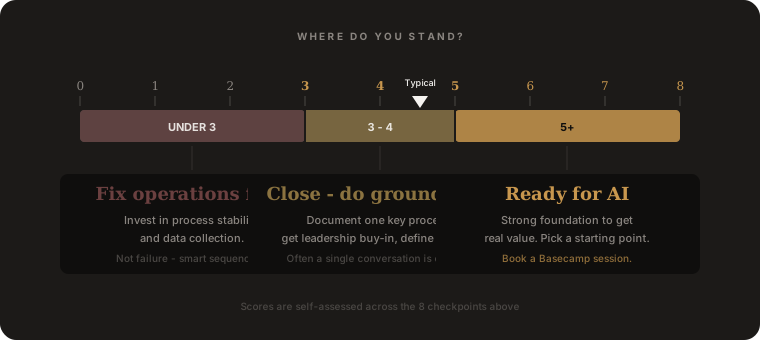
Checked 5 or more? You’re in good shape. Your business has the foundation to get real value from AI. The question is where to start — and that’s a solvable problem.
Checked 3 to 4? You’re close, but there’s some groundwork to do first. That might mean documenting a key process, getting leadership buy-in, or simply defining what success looks like. None of that takes months — sometimes a single focused conversation is enough.
Under 3? Be honest with yourself. The best investment right now is in your operations, not in AI. Get your processes stable, start collecting data, and come back when you have a clear problem to solve. That’s not failure — that’s smart sequencing.
What Happens Next
This checklist is exactly what we cover in a Basecamp session. It’s a free, 45-minute conversation where we look at your specific situation and tell you — straight — whether AI makes sense now, later, or not at all.
No pitch deck. No pressure. Just an honest assessment from people who’d rather turn away a project than set it up to fail.
Want to find out where you stand? Book a free Basecamp session — 45 minutes, no obligation.