How We Cut Report Generation Time by 70% — At Our Own Firm
Before we consulted for anyone else, we had to fix our own house.
We run BNN Wealth, a wealth management practice. We have a research team that produces client-facing reports — portfolio reviews, market outlooks, investment recommendations. These reports are what our clients pay for. They’re the product.
And for a long time, producing them was painfully slow.
Where the Time Actually Went
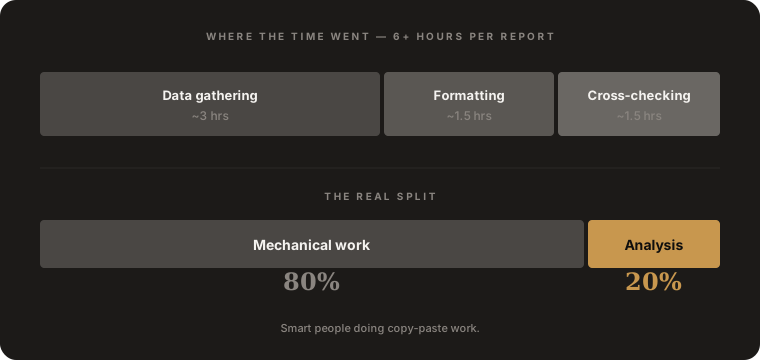
A single client report used to take our analysts 6+ hours. When we finally sat down and mapped the process honestly, the breakdown was brutal:
Data gathering (~3 hours): Market data from trading platforms, NAV feeds, benchmark indices, regulatory updates from SEBI and AMFI, portfolio performance pulled from three different custodian systems. None of these sources talked to each other. An analyst would have four browser tabs open, two Excel sheets, and a notepad, manually pulling numbers and parking them in a staging spreadsheet.
Formatting (~1.5 hours): Every report needed consistent tables, branded headers, properly formatted charts, and a standard structure our clients expected. Analysts would copy-paste from templates, manually adjust column widths, re-label axes, fix font inconsistencies. Every. Single. Time.
Cross-checking (~1.5 hours): The most draining part. Does the NAV in the summary table match the NAV in the holdings breakdown? Does the return calculation match what the custodian statement says? Is the benchmark comparison using the correct date range? At hour five of a report, an analyst staring at columns of numbers will miss things. They know it, and it eats at them.
Here’s the part that bothered us most: our analysts were spending roughly 80% of their time on gathering, formatting, and checking — and only about 20% on the part that actually matters: thinking about what the data means for the client.
We were paying smart people to do copy-paste work.
What We Built
We didn’t go buy an off-the-shelf product. We built tools specific to our workflow, the same way we now build for clients. Three layers:
Automated data pipelines. We connected directly to our market data feeds, custodian APIs, and regulatory sources. When an analyst starts a report, the staging spreadsheet is already populated — current holdings, transaction history, benchmark performance, relevant regulatory changes. No tab-switching, no manual pulls, no transcription errors.
AI-powered report templating. The gathered data flows into structured templates that handle formatting automatically. Tables are consistent. Charts generate from the data with correct labels and date ranges. Branding is locked in. The analyst opens a draft that already looks like a finished report — they just need to add the analysis and recommendations.
Cross-reference validation. Before any human reviews the report, an automated check runs across every number. Does the portfolio return match the sum of individual holding returns? Does the AUM figure in the executive summary match the detailed breakdown? Are the benchmark periods aligned? The system flags discrepancies with specific cell references. Instead of an analyst squinting at spreadsheets for 90 minutes, they review a short list of flagged items — usually zero to two — in about ten minutes.
The Numbers
We tracked everything for six months after rolling out the tools:
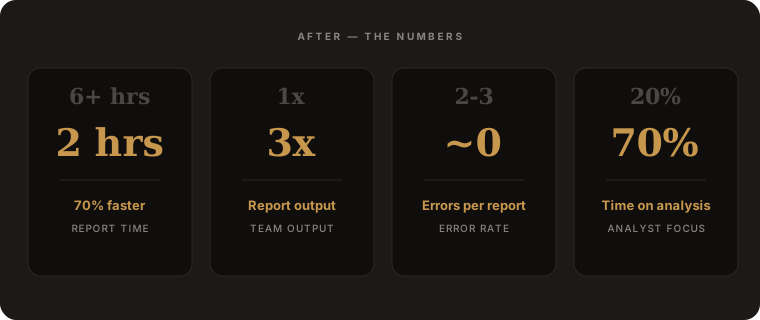
- Report generation time: from 6+ hours down to under 2 hours. That’s the 70%.
- Team output: the same four analysts now produce roughly 3x the reports per month. No new hires.
- Error rate: we used to catch 2-3 discrepancies per report during review. Now automated validation catches them before the analyst even sees the draft. The errors that reach the review stage dropped to near zero.
- Time allocation flip: analysts now spend about 70% of their time on actual analysis — interpreting trends, crafting recommendations, writing the narrative that clients read. Before, that was 20%.
The Win We Didn’t Expect
Here’s what surprised us. We expected faster reports. We expected more output. We got both.
What we didn’t expect was how much happier the team became.
Our analysts joined BNN Wealth because they wanted to analyse markets and advise clients. They didn’t sign up to spend five hours a day wrestling with Excel formatting and triple-checking NAV figures across PDFs. The copy-paste grind was the part of the job they endured, not the part they chose.
Once we removed that grind, something shifted. Report quality went up — not just because of fewer errors, but because the analysts were actually thinking more. Their commentary got sharper. Their recommendations got more nuanced. One analyst told us she started looking forward to report days again.
That doesn’t show up in a metrics dashboard, but it might be the most valuable outcome of the entire project.
Why We’re Telling You This
We could have kept this as an internal win and just used it as a credential in sales calls. But that’s not how we operate.
When a client asks us, “Has this actually worked somewhere?” we don’t want to point to a sanitized case study about some unnamed company. We want to point at ourselves.
We don’t ask clients to do anything we haven’t done ourselves. This is our proof.
The same approach — map the workflow, find where humans are doing machine work, build targeted tools, measure relentlessly — is what we bring to every engagement. The domain changes. The method doesn’t.
Want to see where the same approach could work in your business? Book a free Basecamp session — we’ll show you where the same approach could work for your business.