How a 4-Person CA Firm Handles 200 Clients — With Zero New Hires
I’ll tell you something that took me too long to admit: for the first three years of running my wealth management practice, I was the bottleneck.
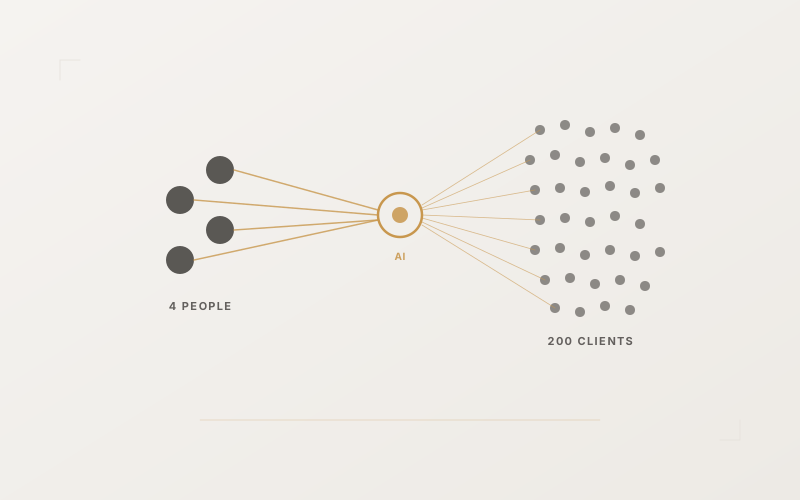
Four people. Me, two associates, and one admin. We managed portfolio reviews, compliance filings, client reconciliation, market research, and everything in between for about 200 clients. On paper, the business was healthy. In reality, I was working 12-hour days and still dropping balls.
The worst part? I knew exactly where the time was going. It wasn’t the advisory work — the portfolio analysis, the client conversations, the strategic calls. That’s the work I trained for. That’s the work that generates revenue. It was everything around the advisory work that was eating me alive.
The ceremonies that ate 60% of my week
Every practice has its rhythms. Daily check-ins, weekly reviews, monthly filings. In our firm, they looked like this:
Monday mornings started with me staring at a spreadsheet trying to figure out which clients I hadn’t spoken to in over 90 days. I’d scroll through our contact log, cross-reference it with the last meeting notes, and manually build a call list. This took about 90 minutes every Monday. Ninety minutes before I’d made a single call.
Tuesdays and Wednesdays were document days. Clients owed us KYC updates, portfolio authorizations, risk profiling forms. The collection process was always the same — send WhatsApp message, wait three days, send reminder, get a blurry photo of a document that should have been a PDF, ask them to resend, wait again. My admin spent roughly 15 hours a week just on document follow-ups.
Thursdays were compliance days. SEBI filings, AMFI registrations, internal audit checklists. I maintained a master tracker in Excel with color-coded due dates. It worked — until it didn’t. I missed a quarterly filing once because the Excel row was hidden by a filter I’d forgotten about. That cost me a penalty notice and a week of sleep.
Fridays were supposed to be for research and client advisory prep. In practice, they were spillover days — catching up on whatever hadn’t gotten done Monday through Thursday.
The math was simple and depressing. Of the 50-odd hours I was working each week, maybe 20 were spent on actual advisory and client-facing work. The other 30 were ceremonies — necessary, repetitive, low-judgment tasks that had to happen but didn’t need me to do them.
I didn’t need another hire. I needed systems that could handle the ceremonies while I focused on the work that only I could do.
What we actually built
I want to be specific here because “we connected AI to our workflow” means nothing. Here’s what actually happened, one piece at a time.
The Monday morning call list
We built a simple system that connects to our CRM (a glorified Google Sheet, honestly) and our call logs. Every Monday at 7 AM, it generates a prioritized call list based on three signals: days since last contact, portfolio size, and whether there’s a pending action item (rebalancing due, SIP review, maturity coming up).
The list hits my WhatsApp as a clean message. Top 8 clients to call today, with a one-line context for each. “Sharma ji — last spoke 94 days ago, SIP in HDFC Balanced due for review, portfolio up 12% since last meeting.”
What used to take me 90 minutes of spreadsheet scrolling now takes zero minutes of my time. Phone uthao aur shuru ho jao.
Here’s what I didn’t expect: my dormant client reactivation rate went up by about 40%. Not because the AI was doing anything magical, but because I was actually calling people I’d been meaning to call. The system didn’t replace judgment — it removed the friction that sat between my intention and my action.
Document collection that sorts itself
This was the big one. Our admin was drowning in WhatsApp messages from clients — documents sent at random times, in random formats, sometimes to her personal number, sometimes to the firm’s number, sometimes forwarded from their spouse’s phone.
We set up a WhatsApp Business integration where clients send documents to one number. The system auto-classifies what comes in. PAN card? Filed under KYC. Bank statement? Filed under financial documents with the date range extracted. Risk profiling form? Flagged as received and the compliance tracker updated.
If a client sends a photo instead of a PDF, the system extracts the text anyway and flags it for quality review. If a document is illegible, it sends a polite reply asking for a clearer copy — automatically, within minutes.
The compliance tracker now shows a real-time dashboard: 147 clients fully compliant, 38 with documents pending, 15 with overdue items. My admin went from spending 15 hours a week chasing documents to about 3 hours reviewing edge cases.
The compliance tracker that WhatsApps reminders
This replaced my color-coded Excel sheet. Every regulatory deadline — SEBI quarterly filings, AMFI registration renewals, KYC update deadlines — sits in a system that does three things:
First, it sends me a summary every Monday of what’s due this week and next week. Not buried in a spreadsheet. A clean WhatsApp message.
Second, for client-facing deadlines, it sends personalized reminders to clients. Not generic blasts — actual specific messages. “Mr. Patel, your KYC re-verification is due by 15th April. Please share your latest Aadhaar and a cancelled cheque. You can send them to this number.”
Third, it escalates. If a deadline is 7 days away and the required action hasn’t been completed, I get a direct alert. No more hidden rows. No more missed filings.
I haven’t received a penalty notice since.
This isn’t a tech story
Here’s what I learned: you don’t need to become a technologist. You need to be honest about where your time goes.
I mapped every task in my week, identified which ones were ceremonies (necessary but not requiring my expertise), and worked with someone who could build systems around them.
The technology behind this is not exotic. It’s WhatsApp Business API, Google Sheets, AI for document classification (OCR plus a fine-tuned classifier that recognizes PAN cards, Form 16s, and bank statements), and n8n workflows connecting them end to end. No machine learning PhD required.
The hard part was being honest about how I was spending my time. Most professionals I talk to — CAs, lawyers, insurance advisors — have the same problem. They know their days are full, but they haven’t sat down and separated the high-judgment work from the ceremonies. Once you do that separation, the path forward is obvious.
What changed
I work about 9 hours a day now, down from 12. My weekends are actually weekends. Char mahine se Saturday ko kaam nahi kiya — my wife still can’t believe it.
But more importantly, the quality of my work changed. I was making 8-10 more advisory calls per week than before — calls that used to get lost in the spreadsheet shuffle. More regular client touchpoints led to deeper conversations about financial goals, and our AUM grew 22% last year. Not because we added clients aggressively, but because existing clients increased their allocations. Jab aap regularly baat karte ho, logon ka trust badhta hai. Who knew.
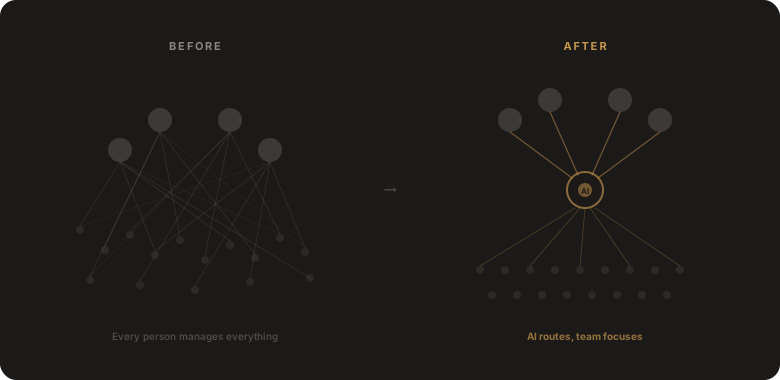
My two associates handle more independently because the systems give them better information upfront. My admin focuses on genuine client service instead of document chasing. The firm runs better, and everyone’s less exhausted.
Four people. 200 clients. Zero new hires. The secret wasn’t working harder or hiring more — it was removing the work that shouldn’t have been manual in the first place.
If your week looks like mine used to — Mondays lost to spreadsheets, Thursdays spent on compliance busywork, Fridays swallowed by spillover — let’s talk. Start with whichever day of the week is killing you.