How a 20-Person CA Firm Handles Filing Season Without Hiring Temps
It’s the last week of March. Your senior is juggling 80 open ITR files. Two articled clerks called in sick. A client just forwarded a blurry photo of their Form 16 on WhatsApp — again. And your phone won’t stop ringing because every second client wants to know: “Sir, mera filing ho gaya kya?”
If you run a CA firm with 15-25 people, you know this season. You’ve lived it for years. The playbook is always the same: hire 5-8 temps in February, spend two weeks training them on your Tally setup and filing workflow, pray they don’t mess up the TDS entries, and then let them go in April. Next year, repeat.
There’s a better way. Not a theoretical one — a systems-level approach that lets your existing team absorb the filing season surge without burning out or compromising accuracy.
The three biggest time sinks in filing season
Before talking about solutions, let’s be honest about where time actually goes. It’s not the filing itself — a competent CA can punch through an ITR-2 or ITR-3 in 20 minutes if the data is clean. The problem is everything around the filing.
1. Chasing clients for documents
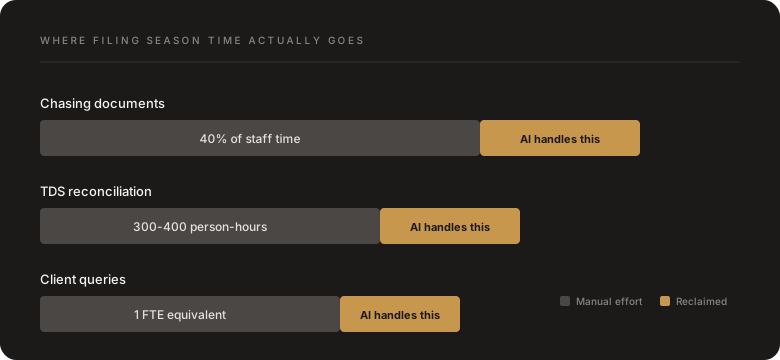
This is the single largest bottleneck. You need bank statements, Form 16s from every employer, investment proofs (80C, 80D, HRA receipts), capital gains statements, AIS data. For a firm handling 400 filings, that’s potentially 2,000+ documents to collect, verify, and organize.
Your staff spends hours sending follow-up WhatsApp messages, calling clients, explaining for the tenth time what “Annual Information Statement” means, and then manually sorting whatever comes back — PDFs, photos, screenshots, forwarded emails with attachments buried three levels deep.
What AI does here: A document ingestion pipeline monitors your firm’s email and WhatsApp Business account. When a client sends documents — in any format — the system extracts structured data automatically. It reads Form 16 PDFs and pulls salary, TDS, and employer details. It parses bank statements (even scanned ones) and categorizes transactions. It cross-references what’s received against a per-client checklist and sends automated follow-ups for what’s missing. Your staff opens the client file and finds pre-filled schedules ready for review, not a pile of raw documents to sift through.
2. TDS reconciliation and mismatch resolution
Every CA firm partner knows the pain of 26AS/AIS mismatches. A client’s employer deposited TDS but the challan reflects a different amount. Or the AIS shows interest income from an FD the client forgot to mention. Or there’s a mismatch between Form 16 Part A and the TRACES record.
Your team manually downloads 26AS for each client, compares line by line against Form 16 and bank statements, identifies discrepancies, and then drafts rectification requests or follows up with deductors. For 400 clients, this reconciliation alone can eat 300-400 person-hours in a season.
What AI does here: An automated reconciliation engine pulls 26AS and AIS data, cross-references it against the client’s Form 16, bank statements, and other submitted documents, and flags every mismatch with a severity classification. Critical mismatches (TDS credit differences above a threshold) get escalated to the assigned CA. Minor mismatches (rounding differences, timing issues) get auto-documented with notes. For common rectification scenarios, the system drafts the rectification request in the correct format, ready for the CA to review and submit. What used to take 45 minutes per client now takes 5 minutes of review time.
3. Client status updates and query handling
“Has my return been filed?” “What’s my refund status?” “Can I still claim that 80C investment?” During peak season, your receptionist and junior staff become a call center. Every interruption breaks someone’s concentration on actual filing work. Multiply that by 400 clients, many of whom call multiple times, and you’ve lost a full-time person just to status updates.
What AI does here: A client-facing status dashboard (accessible via a simple link sent on WhatsApp) shows real-time filing progress — documents received, verification in progress, filed, acknowledgement number. An AI assistant handles the common queries automatically: refund timelines, document requirements, section 80C limits, HRA calculation logic. Only genuinely complex queries — “I sold property this year, how does indexation work?” — get routed to a CA. Your team’s phones stop ringing for routine questions.
The real result: capacity, not just efficiency
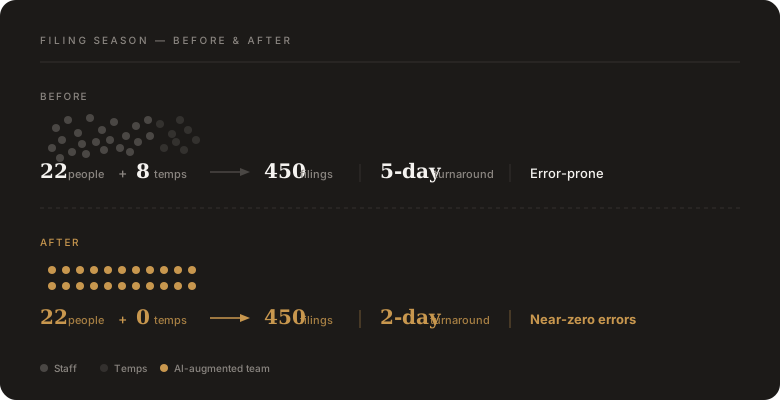
A firm we worked with — 22 people, around 450 filings per season — implemented these three systems before their last filing season. They hired zero temps. Their error rate on TDS reconciliation dropped because the AI doesn’t skip rows when it’s tired at 11 PM. Their average filing turnaround went from 5 days (after receiving documents) to under 2 days.
But the more interesting outcome showed up in the other nine months. The capacity that filing season used to consume — the training, the overtime, the error correction — was now available year-round. That firm used it to launch a GST audit advisory practice and a monthly compliance retainer service for 60 of their clients. Advisory revenue that didn’t exist before, built on capacity they always had but could never access.
This isn’t about replacing your team
No AI system is filing an ITR on its own. Your CAs still review every return. Your seniors still handle complex cases — HUF structures, capital gains with multiple transactions, NRI taxation. The AI handles the mechanical work that was never a good use of a qualified Chartered Accountant’s time in the first place.
Your articled clerks learn faster because they’re reviewing AI-organized data instead of drowning in document chaos. Your partners spend time on advisory conversations with clients instead of chasing Form 16s. Your firm scales without the annual hire-train-fire cycle that costs money and morale every single year.
Filing season doesn’t have to be a survival exercise.
Book a free Basecamp session — we’ll map your filing season bottlenecks in 45 minutes.