5 AI Projects That Failed — And What They Got Wrong
Nobody talks about the failures.
Vendors won’t mention them. Internal teams bury them. Leadership quietly moves on to the next shiny initiative. But the failures are where all the lessons live, and after working with businesses across industries, I’ve seen the same five mistakes play out over and over.
These are real projects. Names and details are changed, but the pain was very real.
1. The Chatbot Nobody Asked For
A mid-sized retail chain — about 40 stores, solid regional presence — decided they needed an AI-powered customer service chatbot. The CEO had seen a demo at a conference. The vendor made it look effortless. Three months and a significant budget later, the chatbot was live on their website.
It could answer questions about store hours and return policies. Nobody was asking those questions. Their website already had a FAQ page that handled it fine.
Meanwhile, store managers were drowning in stockouts and overstocking. The actual pain point — the one costing them real money every single week — was inventory forecasting. They had the sales data. They had the supplier lead times. What they needed was a demand prediction model, not a chatbot that regurgitated their FAQ in a friendlier tone.
The chatbot got 11 conversations in its first month. Eleven.
Lesson: If you start with a solution instead of a problem, you’ll build something nobody needs.
2. The “Automate Everything” Mandate
A manufacturing company’s CEO came back from a Davos-adjacent event full of conviction: “We’re going to automate everything with AI. Every department. Twelve-month deadline.” He announced it in an all-hands meeting.
The operations team panicked. Middle managers saw it as a threat. The IT team — three people strong — was suddenly expected to evaluate AI platforms, manage vendor relationships, and retrain the workforce. All while keeping the ERP system from catching fire, which was their actual full-time job.
Within six weeks, the project had no clear ownership. Within three months, it had no budget. The CEO moved on to talking about blockchain. The employees who’d spent nights worrying about being replaced? They just stopped trusting leadership announcements altogether.
The damage wasn’t just a failed project. It was a trust deficit that made every future change initiative harder.
Lesson: AI adoption without a specific, scoped starting point isn’t a strategy — it’s a press release.
3. The Data That Didn’t Exist
A logistics company with a fleet of about 200 vehicles wanted predictive route optimization. The pitch was compelling: use historical delivery data to predict traffic patterns, optimize fuel consumption, and cut delivery times by 20%.
One problem. Their “historical data” was a collection of Excel sheets maintained differently by each regional office. Some tracked delivery times. Some didn’t. GPS data existed for only 30% of the fleet, and half of that was garbage — drivers turning off trackers or devices losing signal in rural areas. The timestamps were in three different formats across four spreadsheets.
The AI vendor spent two months trying to clean and unify this data. They got it to a point where the model could technically run, but the predictions were meaningless. Garbage in, garbage out — except this garbage cost them eight months and a vendor contract they’re still paying off.
The unsexy truth: before you can do AI, you need to do data. That might mean six months of boring, unglamorous work — standardizing collection, fixing pipelines, training people to log things consistently. Nobody wants to hear that. But it’s the difference between a project that works and one that becomes an expensive cautionary tale.
Lesson: If your data isn’t ready, your AI project isn’t ready. Full stop.
4. The Pilot That Never Shipped
This one still stings because the technology actually worked.
A financial services firm — insurance, specifically — built a document processing pilot that could extract key terms from policy documents in seconds instead of the 25 minutes it took their team manually. The POC was flawless. Accuracy was above 95%. The team that tested it loved it.
Then the project lead who championed it got promoted to a different division. The new person in the seat had different priorities. IT raised concerns about integration with the legacy claims system. Compliance wanted a six-month review. The operations head who’d originally requested it retired.
Eighteen months later, the pilot is still sitting in a sandbox environment. The team that tested it went back to manually reading documents. They occasionally joke about “that AI thing that worked great and then disappeared.”
This is more common than anyone admits. A successful POC means nothing without organizational momentum — a champion with authority, a deployment plan with dates, and executive air cover when the inevitable objections arise.
Lesson: Technology doesn’t ship itself. Without an internal champion and a clear path to production, even great pilots die on the vine.
5. The One-Size-Fits-All Vendor
A professional services firm — 50 people, mostly accountants and compliance specialists — got sold an enterprise AI platform designed for companies with 5,000+ employees. The platform could do everything: NLP, computer vision, predictive analytics, recommendation engines, the works.
They needed exactly one thing: automated data extraction from scanned invoices.
The platform required a dedicated admin. It needed its own infrastructure. The training alone took three weeks. The monthly licensing fee was more than some of their employees’ salaries. And the invoice extraction feature? It was buried four menus deep and worked about as well as a free open-source tool that one of their junior analysts had found on GitHub.
After a year of trying to justify the cost by finding more use cases — “maybe we can use the computer vision module for… something?” — they cancelled the contract. Total spend: enough to have built a custom solution three times over, with money left for a team offsite.
Lesson: Buy for the problem you have today, not the platform you might theoretically grow into.
The Common Thread
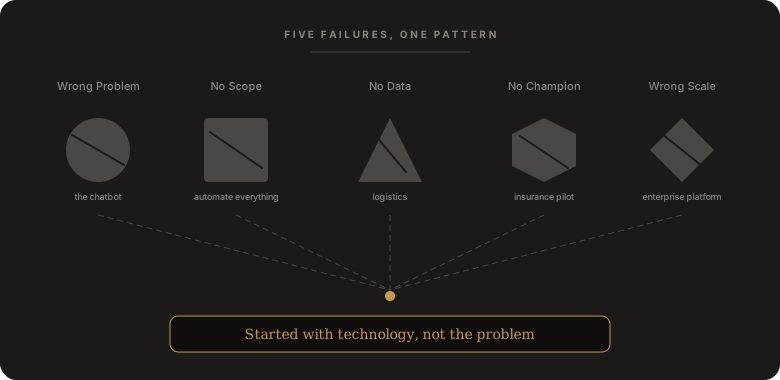
Five different companies. Five different industries. One pattern.
Every single one of these projects started with technology and worked backward toward a business problem. The chatbot started with “let’s do AI.” The automation mandate started with a buzzword. The logistics project started with a vendor pitch. The pilot died because nobody connected it to business outcomes that mattered to the new leadership. The platform purchase started with a feature list instead of a requirements list.
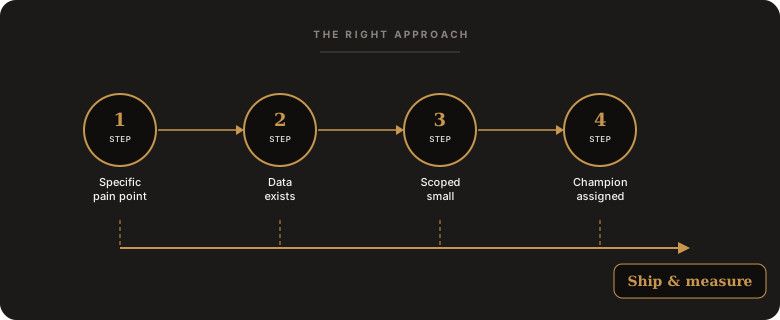
The companies that get AI right do the opposite. They start with a specific, measurable pain point. They scope small. They make sure the data exists. They assign someone who cares enough to push it past the inevitable friction. And they pick tools that match their actual size and needs, not their aspirations.
It’s not complicated. But it requires the discipline to say “not yet” to exciting technology until you’ve done the boring work of understanding your own operations.
Thinking about an AI initiative? Before you spend a rupee, spend 45 minutes with us. Book a free Basecamp session — we’ll tell you honestly whether you’re ready, and where to start if you are.