Filing Season Survival Guide — The AI Edition

Filing season breaks people. Not the work itself — any CA can file a return in their sleep. It’s the hundred other things: chasing documents from clients who vanish until July 25th, fielding “mera refund kab aayega?” calls while computing TDS for 40 companies, watching your best staff burn out by August. You mix up Sharma’s bank statement with the other Sharma’s Form 16 — and there are always too many Sharmas.
Har saal ka yahi rona dhona hai. But this year, something was different. I spent the last year building specific fixes — some AI-powered, some just better systems — for the exact pain points that make July-September miserable. All of them are things any CA firm in India can implement.
This is that survival guide, from one practitioner to another.
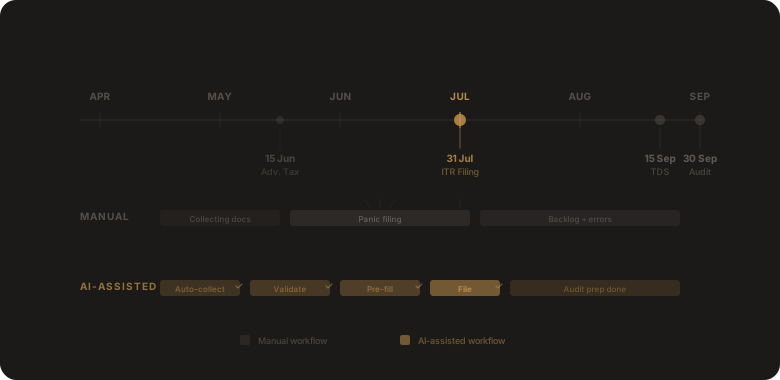
Pain Point 1: The 31 July ITR rush
You know the math. Roughly 60-70% of your individual ITR filings will come in the last two weeks before the 31 July deadline. Not because your clients are irresponsible (well, some are), but because many of them genuinely don’t have all their documents ready until late June — Form 16 comes late, capital gains statements from brokers take time, AIS data needs verification.
The manual way: Your staff works 14-16 hour days in the last two weeks. You hire temporary staff who need training. Quality drops because everyone is exhausted. You file 30 returns a day and pray you haven’t mixed up Sharma’s bank statement with Sharma’s Form 16 (there are always too many Sharmas).
The AI way: Start document collection in May, not July. I know what you’re thinking — “clients won’t send in May.” They will if you make it easy. A WhatsApp-based document collection system with automated reminders, starting 60 days before the deadline, spreads the load. Clients who would have sent everything in a panic on July 25th instead trickle in through June.
The system tracks who’s complete and who isn’t. By July 1st, you know exactly which clients are ready to file and which need follow-up. You can start filing the complete ones immediately, instead of waiting for the rush.
One firm I advised started filing completed returns from June 15th onwards last year. By the time the July rush hit, they’d already filed 40% of their individual returns. The last two weeks went from chaos to manageable.
Pain Point 2: TDS return filing — the 15 September wall
Here’s one that gets less attention but causes equal stress. Quarterly TDS returns (Form 24Q, 26Q, 27Q) for Q1 are due by 15 September. If you’re handling TDS compliance for 40-50 companies, that’s 100-150 returns that need to be filed — while you’re still finishing the ITR rush from July.
The manual way: Your staff downloads salary registers and payment records from each client’s Tally or accounting system, manually prepares the TDS computation, generates the FVU file, validates it, corrects the 15 errors that always come up, and files. Each return takes 2-3 hours of a competent person’s time. Multiply by 120 returns and you need 360 hours of work in about 20 working days. That’s 2-3 full-time people doing nothing but TDS — people you don’t have because they’re finishing ITR filings.
The AI way: Automated data extraction from Tally. For clients who use Tally (which is most of them), the system pulls salary registers, vendor payment details, and TDS deduction data directly. It pre-fills the return based on standard computation rules. The staff’s job shifts from data entry to review — checking the pre-filled return against source documents, handling exceptions (short deductions, late deposits, section mismatches), and filing.
What used to take 2-3 hours per return takes about 30-40 minutes of review time. The system flags anomalies — “TDS deducted at 10% but the payee doesn’t have a PAN, should be 20%” — before your staff even opens the file.
Where this broke down: The extraction doesn’t handle every edge case. One firm had vendors who submitted invoices with handwritten PAN numbers — the OCR misread two of them, which led to mismatched challans. They caught it during review, but it added an hour of rework per batch. Automated extraction is fast, not infallible. You still need someone who knows what a wrong PAN looks like.
Pain Point 3: Client queries during peak season
“Sir, mera ITR file ho gaya kya?” “Refund kab tak aayega?” “Meri wife ka bhi filing karna hai, uska kya status hai?” “Last year ka 26AS mein ek mismatch tha, woh resolve hua?”
During filing season, your phone becomes a customer service hotline. Every call breaks concentration. Your receptionist, if you have one, can answer about 30% of these queries. The rest need someone who actually knows the client’s file status.
The manual way: You answer calls. Or you don’t answer, and clients get anxious and call more. Or your articled clerk answers and gives incorrect information. Or you send a bulk WhatsApp saying “All filings in progress, please don’t call” — which never works.
The AI way: A client-facing status system. Each client gets a personalized WhatsApp message they can check anytime: “Your ITR-2 filing status: Documents received and verified. Return preparation in progress. Expected filing date: 22 July.” When the status changes — filed, acknowledged, refund processed — they get an automatic update.
For common queries — “when will I get my refund?” “what is Section 80C limit?” “can I still invest in ELSS?” — an AI assistant handles the response automatically with accurate, current information. Complex queries get routed to the assigned staff member with context, so when they do take a call, they’re not starting from scratch.
The firm I mentioned earlier saw a 70% drop in client calls during peak season after implementing this. That’s not just saved time — it’s saved attention. Every call your staff doesn’t take is 10 minutes of unbroken focus on actual filing work.
Pain Point 4: Staff on leave — the domino effect
It never fails. Your most reliable senior takes leave in August — family wedding, planned months in advance. Your articled clerk has exams. Your admin gets sick from overwork. Suddenly, the 5 people who were barely managing the load become 3 people.
The manual way: You personally absorb the extra work. You stop sleeping. The remaining staff burns out faster. Quality drops. Deadlines get missed. Someone makes a mistake on a TDS return because they’re handling twice their usual load.
The AI way: This isn’t an AI solution per se — it’s a systems solution that AI enables. When your workflows are documented in systems rather than in people’s heads, losing a person doesn’t mean losing the institutional knowledge of where 40 client files stand. The compliance tracker shows exactly what’s pending, who’s assigned, what’s next. The document collection system keeps running whether Ritu is in the office or at her cousin’s wedding.
When a team member is unavailable, you reassign their clients in the system. The new person picks up with full context — documents received, return status, pending items, client communication history. No “let me figure out where Ritu was on the Mehta file.”
When the system goes down on July 28th
Because it will. Server crashes. WhatsApp API rate-limits you during peak traffic. The Tally connector throws an error because a client upgraded to a new version mid-season. Murphy’s law doesn’t take filing-season holidays.
Here’s what we learned the hard way: every automated workflow needs a manual fallback that your team can execute without the system. Document it. Print it out. Tape it to the wall if you have to. The WhatsApp reminder system goes down? Your receptionist has the client list sorted by status — she makes calls the old-fashioned way. The Tally extraction breaks? Your staff knows how to pull the salary register manually; they just haven’t had to in months.
Koi bhi system 100% reliable nahi hota. The goal isn’t eliminating manual work — it’s making manual work the exception instead of the default. When July 28th breaks something (and it will), you lose a few hours, not a few days.
What filing season actually feels like after these changes
Filing season is still hard. The deadlines don’t move. The regulations get more complex every year. Clients still send blurry photos of their Form 16 at 11 PM on July 30th — aur phir phone karke poochhte hain, “mil gaya na?”
The difference is between difficult and chaotic. One firm that implemented the document collection system and compliance tracker last year told me their staff still worked 12-hour days in the last week of July — but nobody worked past midnight, nobody made a filing error from exhaustion, and nobody quit in September. That’s not a transformation. That’s 15-20% less misery. Sometimes that’s enough.
If you’re a CA firm reading this, don’t try to fix all four pain points. Pick the one that made you lose sleep last July. Just that one. Fix it before this July hits. If it shaves even a few hours off your worst week, you’ll know whether the second fix is worth building.
Filing season aa raha hai. Sharma ka Form 16 bhi aa raha hai — aur doosre Sharma ka bhi.
Which pain point costs you the most hours in July? Describe it here — one problem, one week, ₹29,999. Start before the rush does.