How a 15-Person Company Competes Like a 50-Person One
There’s a moment every growing business hits. You need things done — real, critical work — but you don’t have the people to do it. And you can’t afford to hire them yet.
Your CA firm needs deep regulatory research, but you’ve got three people handling compliance, client queries, and filing all at once. Your manufacturing unit needs someone crunching quality data, but a full-time analyst costs more than the margin on your best product line.
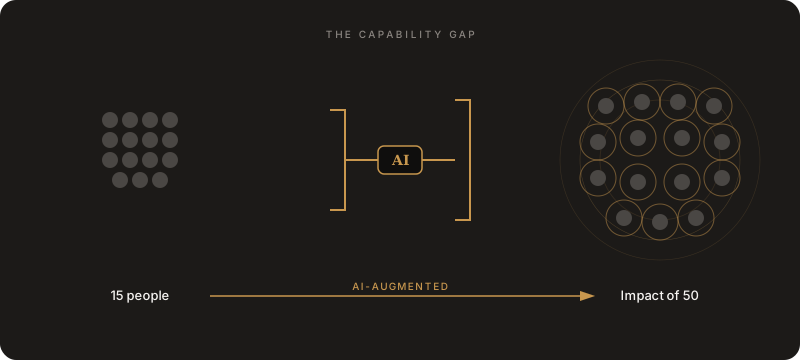
This is the capability gap. And it’s the single biggest constraint on small and mid-size businesses trying to compete with larger players.
Why Hiring Isn’t Always the Answer
The instinct is to hire. But hiring is slow, expensive, and risky — especially for specialized roles.
A good data analyst costs 8-12 lakhs a year. A regulatory research specialist? More. A multilingual content team? Now you’re looking at three hires minimum.
For a 15-person company doing 3-5 crore in revenue, those hires are a bet. You’re committing fixed costs against uncertain returns. And if the work is important but not full-time — say, 15 hours a week of research spread across clients — you can’t justify a full seat for it.
So the work either doesn’t get done, gets done badly by someone stretched too thin, or gets done by the founder at midnight. None of those options scale.
Where AI Actually Plugs In
AI doesn’t replace your team. It fills the gaps between what your team can do and what your business needs done. Here’s what that looks like in practice:
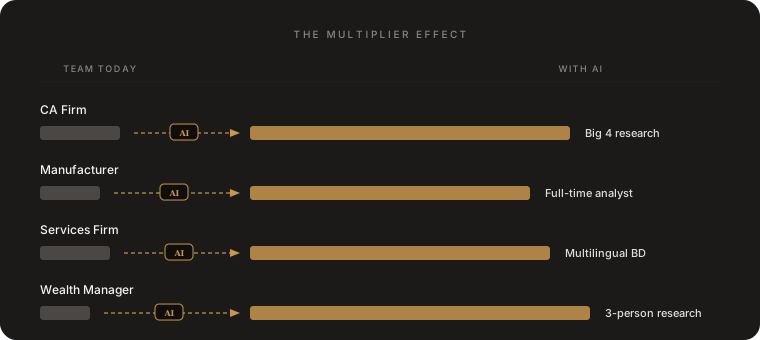
A 12-person CA firm that needs Big 4-level research capacity. Their clients ask complex questions — GST implications of a new structure, FEMA compliance for an overseas subsidiary, changes in ITR filing rules. Researching each one properly takes hours. With AI-powered regulatory scanning and client brief generation, the same team produces thorough, well-sourced briefs in a fraction of the time. The senior partner reviews and refines. The output quality goes up. The turnaround time drops.
A manufacturer who needs a data analyst but can’t justify the salary. Quality data sits in spreadsheets. Defect rates, supplier performance, production cycle times — all logged, none analysed. An AI dashboard pulls this data, spots trends, and flags anomalies automatically. The operations manager gets a weekly summary that would have taken a full-time analyst two days to prepare. No new hire. Just better decisions from data you already had.
A services firm that needs multilingual proposals but only has English writers. You’re bidding on a project in Gujarat. Or pitching a Japanese client’s India subsidiary. Your team writes excellent proposals — in English. AI handles the translation with tone adaptation, so the Gujarati version doesn’t read like Google Translate output. It sounds like someone who actually speaks the language wrote it. Your three-person BD team now covers markets they couldn’t before.
A small wealth manager who needs market research that would take a team of three. Morning research for client portfolios — sector analysis, global cues, regulatory changes, earnings summaries. Doing this manually means one analyst spending half their day just gathering and formatting. AI pulls from multiple sources, synthesizes the relevant bits, and formats a client-ready report. What took half a day now takes an hour of review and refinement.
The Multiplier Effect
Notice what’s happening in every example above. Nobody got replaced. The existing team got stronger.
That’s the real promise of AI for growing businesses — not automation for its own sake, but capability multiplication. Your 15-person company starts operating like a 50-person one. Your people spend their time on judgment, relationships, and decisions instead of gathering, formatting, and searching.
The CA still reviews every brief. The operations manager still makes the call. The BD lead still shapes the pitch. But they’re working with better inputs, faster.
This is what punching above your weight actually looks like.
How to Find Your Gaps
Start with a simple question: what work is not getting done — or getting done poorly — because you don’t have the right person for it?
Make a list. Be honest. Common answers:
- Data analysis that nobody has time for
- Research that’s either skipped or shallow
- Client communication in languages your team doesn’t speak
- Report generation that eats senior people’s time
- Proposal writing that’s slower than your pipeline needs
Each of these is a capability gap. And most of them are exactly the kind of structured, information-heavy work that AI handles well.
You don’t need to solve all of them at once. Pick the one that’s costing you the most — in lost revenue, slow turnaround, or founder time — and start there.
Not sure where your biggest gap is? Book a free Basecamp session — we’ll map your capability gaps in 45 minutes.