₹29,999 Mein Kya Ban Sakta Hai — 5 Real Examples
The most common question we get — from factory owners, CA firms, insurance agents, everyone — is some version of: “Yeh sab sunne mein accha lagta hai, but realistically, ₹29,999 mein kya ho sakta hai?”
Fair question. The enterprise AI vendors quote ₹5 lakh setup, ₹50,000/month, 3-month implementation. For an Indian SME doing ₹2-5 crore in revenue, that’s not a solution — it’s a financial risk. So let me show you what ₹29,999 actually buys. Five real builds. Real businesses. Real problems solved in 7 days.
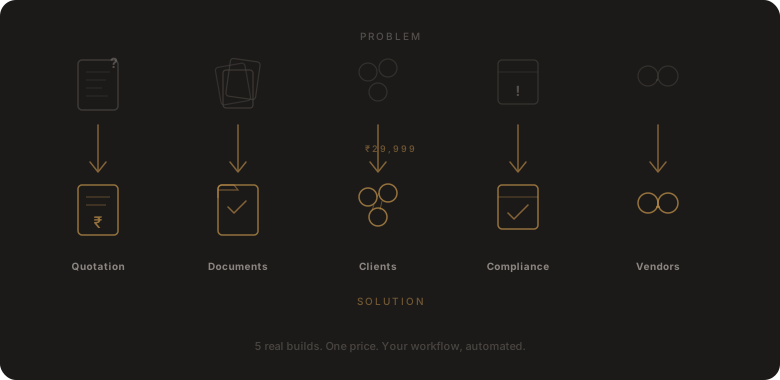
1. Quotation engine for a Pune auto-parts factory
The problem: A factory in Pune that makes precision auto components was losing orders because their quotations took too long. Every RFQ that came in — via email, WhatsApp, sometimes a phone call — had to be manually processed. The production manager would look up raw material costs (which change weekly), check machine availability, calculate machining time based on the part specs, add overheads, and finally type up a quotation in Excel. Average time: 40 minutes per quote. On a busy day with 8-10 RFQs, that’s half a day gone — and by the time the quote went out, the buyer had already heard back from two other suppliers.
What we built: A WhatsApp-based system where the sales team forwards the RFQ (PDF, photo, or text). AI extracts the part specifications — dimensions, material grade, quantity, surface finish requirements. It pulls current raw material prices from their supplier rate cards (updated weekly in a shared sheet), calculates machining time using their standard formulas, applies overhead margins, and generates a formatted quotation PDF. The sales person reviews it on their phone, taps approve, and the quote goes to the buyer — on WhatsApp itself.
The result: Quotation time dropped from 40 minutes to about 3 minutes (most of that is the human review). They started responding to RFQs within the hour. Their quote-to-order conversion improved because they were consistently the first or second supplier to respond. The production manager got half his day back.
2. Document collection bot for a CA firm in Mumbai
The problem: A 6-person CA firm handling about 300 ITR filings every season. The single biggest time sink wasn’t the filing — it was collecting documents from clients. PAN card, Form 16, bank statements, investment proofs, capital gains statement. Each client owes 4-5 documents. The firm’s staff would send a WhatsApp checklist, wait, remind, get a blurry photo, ask for a proper scan, wait again. For 300 clients, this chase cycle consumed nearly 400 person-hours per filing season.
What we built: A WhatsApp-based document intake system. Each client gets a personalized message with their pending document list. When they send something — photo, PDF, forwarded email, even a screenshot — the AI identifies what it is. PAN card photo? Classified, OCR’d, filed. Form 16 PDF? Parsed, data extracted, filed under the right client. Bank statement for the wrong period? Auto-reply asking for the correct date range.
A real-time tracker shows the CA which clients are complete, which have partial submissions, and which haven’t responded at all. Automated reminders go out on a configurable schedule — day 3, day 7, day 14 — with increasing urgency but always polite.
The result: Document collection time dropped by roughly 60%. The staff that used to spend 3-4 hours a day on follow-ups now spends about an hour reviewing edge cases. More importantly, clients found it easier — they just WhatsApp their documents and get instant confirmation. One long-time client told the partner: “Aaj kal toh aapka system bahut smooth ho gaya hai. Pehle toh har hafte reminder aata tha.”
3. Dormant client reactivation for an insurance agent in Nashik
The problem: An independent insurance agent with a book of about 800 clients across life, health, and motor insurance. Renewals were tracked in an Excel sheet. But beyond renewals, she had no systematic way to identify clients who might need additional coverage — life events like a child’s birth, a home purchase, a job change. She knew these conversations were where the real revenue was, but she had no time to sift through 800 records and figure out whom to call.
What we built: A weekly intelligence digest. The system connects to her client database (an Excel sheet, let’s be honest) and cross-references it with policy maturity dates, family information she’d recorded over the years, and coverage gap analysis. Every Monday morning, she gets a WhatsApp message with 10-12 prioritized client actions: “Mehra family — daughter turning 18 in 2 months, no term plan on husband. Call to discuss child education plan + term insurance.” Or: “Joshi ji — motor policy renewal in 15 days, currently on third-party only, good candidate for comprehensive with NCB transfer.”
The result: She went from making about 5-6 ad hoc calls per week to 10-12 targeted calls with specific talking points. Her cross-sell rate doubled in three months. Revenue from new policies (not renewals) went up by about 35% over the same period.
Her words — and this is the best description I’ve heard of what these systems actually do:
“Pehle mujhe client ke baare mein sochna padta tha. Ab system mujhe bata deta hai ki kisse kya baat karni hai.”
4. Compliance tracker for a CA firm in Thane
The problem: A CA firm managing GST, TDS, and ROC compliance for about 50 companies. Due dates are scattered across the calendar — GSTR-1 by 11th, GSTR-3B by 20th, TDS by 7th, advance tax quarterly, ROC annual filings, and a dozen others depending on the client type. The partner tracked everything in an Excel sheet with conditional formatting. It worked until it didn’t — missed a TDS filing for one client because the row was sorted out of view. ₹10,000 penalty. More importantly, a very uncomfortable conversation with the client.
What we built: A compliance calendar system that connects to their client master list and auto-generates all applicable due dates based on entity type (company, LLP, proprietorship, trust). It sends three layers of reminders: to the assigned staff member (7 days before), to the partner (3 days before), and an escalation to both plus the client (1 day before, if not yet filed). All via WhatsApp. Filing confirmation is logged by the staff member with one tap. The partner gets a weekly dashboard — green, yellow, red — showing compliance status across all 50 clients.
The result: Zero missed deadlines since implementation. The partner stopped losing sleep over whether someone had filed the GSTR-3B. The staff became more accountable because the system made task ownership visible — no more “I thought you were doing that one.” The ₹10,000 penalty that triggered the whole project paid for a third of the system.
5. Vendor follow-up automation for a garment factory in Tirupur
The problem: A garment export unit with 15-20 active fabric and trim vendors. Orders placed via WhatsApp (as is standard in Tirupur). The production manager tracked delivery commitments in a diary — yes, a physical diary. When a vendor was late, he’d notice only when the production floor ran out of material. By then, the export shipment deadline was at risk, and the options were expensive: air-freight the fabric, pay overtime, or worst case, miss the buyer’s deadline and face a penalty.
What we built: A vendor order tracking system. When the production manager places an order (still on WhatsApp — we didn’t change his habit), the system logs it with the committed delivery date. Two days before the due date, an automated message goes to the vendor: “Bhai, 200 meters navy cotton twill ka delivery kal hai. Confirm kar do.” If the vendor confirms, it’s logged. If there’s no response, the production manager gets an alert. If the vendor says there’s a delay, the system flags which production orders are impacted and by how many days.
The result: The factory went from reactive (discovering delays on the production floor) to proactive (knowing about delays 2-3 days in advance). In the first quarter, they tracked 127 vendor deliveries through the system — 19 flagged as at-risk, 14 resolved before they could stall production. The production manager estimated they avoided at least 4-5 last-minute air-freight situations, saving roughly ₹2-3 lakh in expediting costs. The system cost ₹29,999.
What happens after Day 7
A working system in production is just the start. Every build comes with 30 days of support — bug fixes, edge cases we missed, adjustments as real usage surfaces real problems. After that, the system runs on its own. Most clients pay nothing beyond the initial ₹29,999. A few come back a month or two later with a second problem they want solved. That’s fine — it’s a second engagement, not a retainer. We don’t do recurring revenue traps. If the system breaks and it’s our fault, we fix it for free. If you want a new feature, that’s a new conversation.
If any of these sound like problems you’re dealing with, see what we build for your industry or for professional services. One system, one week, ₹29,999.